
Agricultural Meteorology and Evapo-transpiration – theory and practice. Taught by Shabtai Cohen
The course was taught at Shanghai Jiao Tong University in 2024 and 2025.
A previous similar course, called "Bio-meteorology and evapotranspiration: Theory and practice", was taught online at Beijing Normal University in 2020 2021 and 2022.
The objective is to give the students knowledge in the field of agricultural micro-meteorology, including an understanding of states in and processes between the surface and the lower atmosphere.
Basic lectures cover radiation at the surface and lower atmosphere, temperature, humidity and wind. We discuss radiation balance, fluxes of sensible and latent heat, and the determination of reference evapotranspiration (ET) with semi-empirical and theoretical models, leading to the Penman Monteith model. Theory and practical aspects are taught about measurements of Eddy Covariance, and Sap Flow. Theory of radiation distribution in plant stands lead to methods for measuring leaf area index.
The course continues to concepts of decoupling of ET based on the Priestley Taylor model, canopy conductance and iso-hydric control of ET in some plants. We also touch on urban climate and human thermal comfort and crop water stress index.
After completion of the course the student should be able to:
-
Plan, select sensors for, and build a meteorological station for agricultural use.
-
Understand the use of the various sensors used in agricultural meteorology.
-
Evaluate and analyze data from Energy balance, Eddy Covariance, Sap Flow and Leaf Area index measurement systems.
-
Connect sensors to data loggers and carry out basic measurements.
-
Understand and use the Penman-Monteith Equation for reference ET.
-
Use CROPWAT software to build an irrigation table for several crops.
-
Prepare a presentation on topics in Agricultural -meteorology.



Section Title
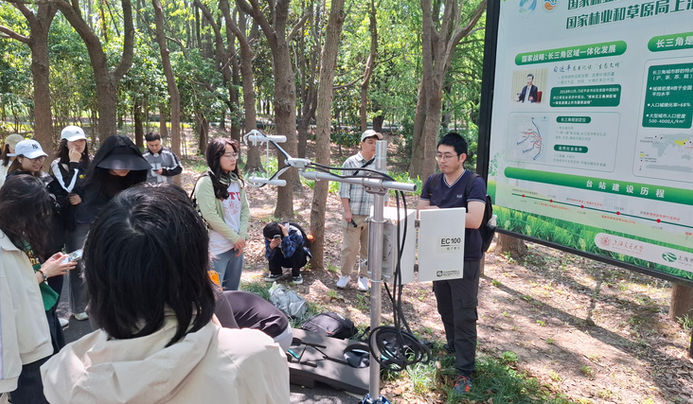
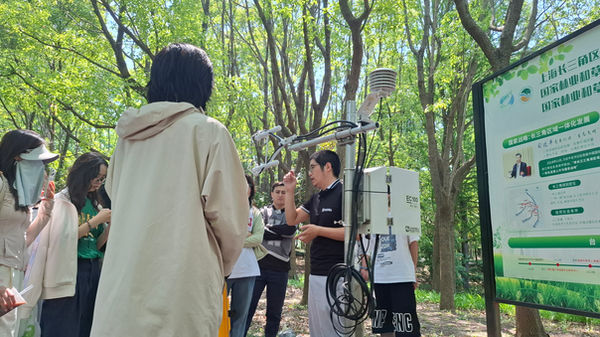
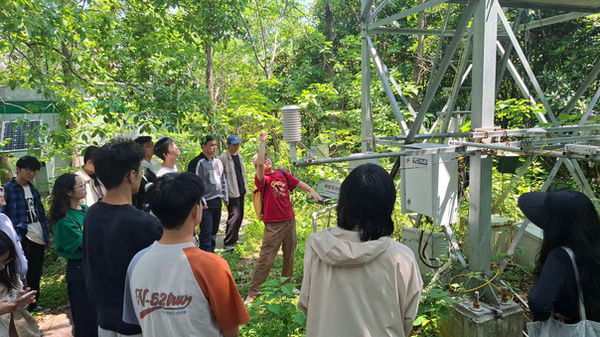
These courses were a great opportunity for me to become familiar with China and Chinese students. I was very impressed by China and how China has progressed so fast in recent years. The students are polite and interested in the material that I taught which is not taught in other courses at the University. The also appreciated the hands-on lab/demo sessions as well as the field trip to the Pudong flux tower site.
Topics covered (36 hours):
-
General introduction - What is agricultural meteorology? Temporal and spatial scales
-
Data collection, digital/analog data, resolution and accuracy, equipment specifications, sampling and standard error of the mean.
-
Temperature and its measurement. Thermocouples, thermopiles, thermistors and other temperature sensors
-
Humidity and its measurement. The psychrometric diagram, water vapor pressure, dew point and vapor pressure deficit (VPD).
-
Radiation introduction - basic principles and equations. Radiation units.
-
Global radiation and Photosynthetic radiation (PAR)
-
Longwave/shortwave radiation and radiation balance
-
Radiation instrumentation
-
Radiation distribution in plant stands
-
Leaf Area Index and its measurement with radiation sensors – theory and instrumentation.
-
Wind and wind profiles. Wind measurement.
-
Laminar and turbulent boundary layers. Atmospheric stability
-
Eddy covariance flux measurements
-
Pan, lysimeters and crop factors
-
Evaporation estimation. Stanhill model and Bowen ratio method.
-
Penman equation theory and use for calculating reference Evapo-transpiration (ET).
-
CROPWAT model for irrigation scheduling based on Penman ET data.
-
Sap flow methods – theory and instrumentation.
-
Priestley-Taylor model, equilibrium evaporation and decoupling
-
Canopy conductance and its behavior, Isohydricity of tree water use.
-
Crop Water Stress Index (CWSI) and thermal remote sensing
-
Human thermal comfort, mean radiant temperature
23. Urban climate and vegetation influence