
How Can Crop Yield Forecasting Support Food Security?

Agricultural production is highly dependent on weather and climate. Rainfall, temperature, radiation and soil water availability interact throughout the growing season to determine crop yield.
Under increasing climate variability, crop yield forecasting can provide early information on expected production, helping farmers and decision-makers prepare for water shortages and production risks.
From Weather to Crop Yield
Crop models combine information about weather, soil conditions and plant development to simulate crop growth throughout the season.
Coupled with weather and climate prediction systems, they translate forecasts into information relevant to agriculture: how much yield to expect, where production is at risk, and when management can still make a difference.
Wheat as a Test Case for Israel
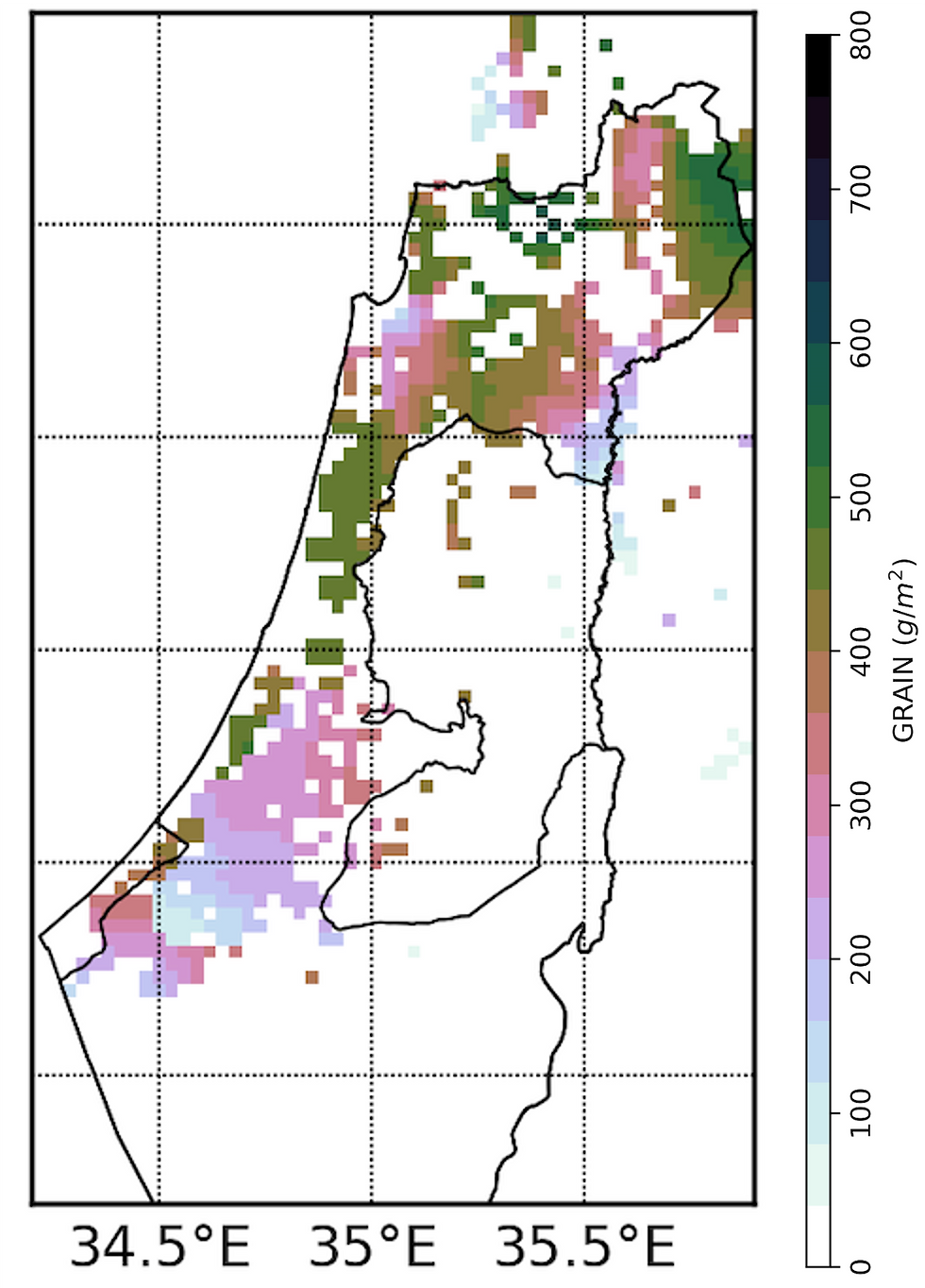
Wheat is Israel’s most widely cultivated crop and is grown mainly under rain-fed conditions, so production varies considerably between years and regions, making it an ideal test case for yield forecasting.
Scientists at the Institute of Soil, Water and Environmental Sciences are developing a high-resolution modelling framework that uses the regional climate model WRF coupled with the dynamic crop model Noah-MP-Crop.
The system was calibrated with observations from commercial wheat fields and applied at approximately 3-km resolution over 30 growing seasons, allowing us to investigate how climate and soil conditions influence wheat production across Israel.
Toward Operational Crop Forecasting
Our goal is to turn crop modelling into a practical decision-making tool. By integrating current soil and crop observations with weather and seasonal climate predictions, crop models could deliver yield forecasts updated throughout the season.
What Have We Learned?
Soil Water Availability: Yield rises strongly with available soil water, but not linearly — below about 70% plant-available water, potential yield falls rapidly.
Timing Matters: Early-season water availability matters more for final yield than late-season water; early stress limits development and the capacity to recover.
Location and Soil Matter: Soil properties and local climate interact to determine both yield potential and water-use efficiency.
Yield vs. Efficiency: The conditions producing the highest yields are not those with the highest water-use efficiency.
What Can It Be Used For?
Identify Risk: Detect emerging production risks before sowing.
Target Irrigation: Direct supplemental irrigation to the locations and growth stages where it helps most.
Improve Water Allocation: Consider expected yield together with water-use efficiency.
Support Production Assessments: Improve preparedness for seasons with unusually low yields and high uncertainty.
From Climate Information to Food-Security Decisions
Crop forecasting bridges climate science, agricultural research and food-security planning, identifying risks while there is still time to respond.
Locally adapted crop-yield forecasting can help Israel use land and water more efficiently and strengthen the resilience of domestic food production.

Join the Conversation
Innovations in soil and water management are essential to ensuring food security for future generations. Stay connected with the latest research and breakthroughs from the Institute of Soil, Water, and Environmental Sciences at ARO's Volcani Institute.
For more information on our research and partnerships, visit us here.

